
The Global Synapse: How AI Connects the World and Reshapes Work
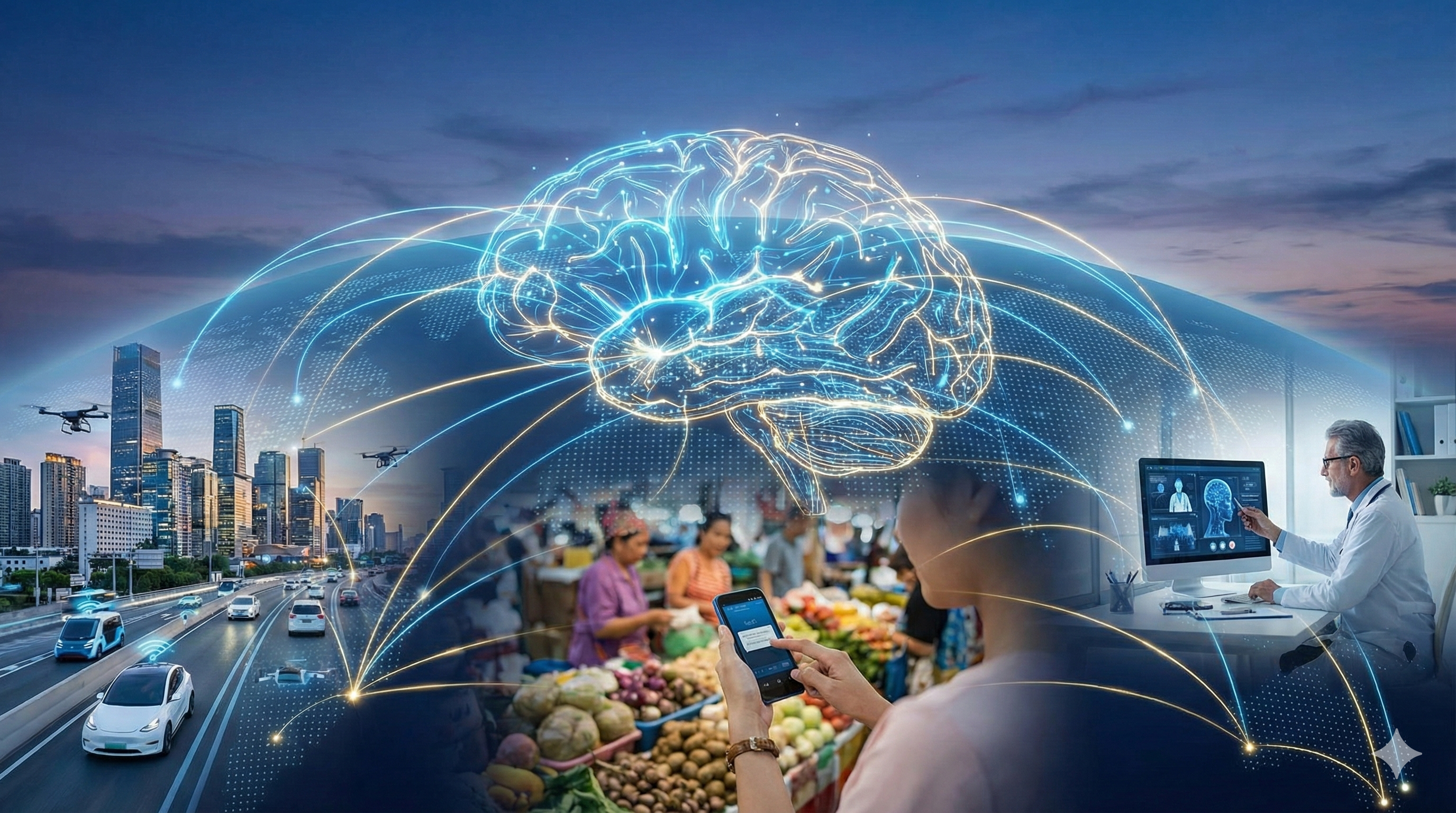
The Global Synapse: How AI Connects the World and Reshapes Work
For decades, the internet has been the world's nervous system, transmitting data across oceans in milliseconds. But if the internet is the nerves, Artificial Intelligence (AI) is becoming the brain—processing, understanding, and connecting us in ways raw data never could. As we stand on the brink of this new era, we are witnessing a paradox: AI is linking humanity closer together while simultaneously threatening the traditional ways we earn our living.
Linking the World: The Universal Translator
The most immediate way AI links the world is by shattering the language barrier. Real-time translation tools are no longer clumsy novelties; they are becoming seamless bridges. A developer in Tokyo can collaborate instantly with a designer in Brazil, with AI mediating the conversation to preserve nuance and intent.
Beyond language, AI connects global logistics and knowledge. Supply chains that span continents are now optimized by algorithms that predict weather patterns, demand spikes, and shipping routes, creating a "global hum" of efficiency. In healthcare, AI models trained in one country can diagnose rare diseases in another, effectively democratizing top-tier medical expertise. We are moving toward a world where geography is no longer a limit to collaboration or care.

The Disruption: Jobs on the Brink
However, this hyper-efficiency comes with a cost. As AI becomes capable of performing complex cognitive tasks, the landscape of employment is shifting beneath our feet. The roles most at risk are no longer just manual labor, but "white-collar" jobs that rely on routine and repetition.
Jobs likely to face significant displacement include:
Data Entry and Processing: AI can process millions of documents in seconds with higher accuracy than humans. Roles dedicated to manually inputting or sorting data are rapidly becoming obsolete.
Basic Customer Service: While human empathy is irreplaceable, Tier 1 support—answering FAQs, tracking orders, and basic troubleshooting—is already being dominated by sophisticated chatbots and voice agents.
Translation and Transcription: While high-level literary translation requires a human touch, technical translation and audio transcription are increasingly automated.
Routine Coding and Testing: AI tools can now write boilerplate code, debug software, and run test scenarios faster than junior developers, shifting the human role from "writer" to "architect."
content Generation: Basic copywriting for SEO, standardized news reports, and generic marketing copy are easily generated by Large Language Models (LLMs).
The Path Forward
The disappearance of these jobs does not necessarily mean the end of work, but rather a transformation. Just as the industrial revolution replaced artisans with machine operators, the AI revolution will require "AI operators"—people who can guide, correct, and curate the output of intelligent systems. The future belongs not to those who can do what machines do, but to those who can do what machines cannot: think critically, empathize deeply, and innovate creatively.